Enjoy ₹100 OFF on orders over ₹499, plus a FREE surprise gift on orders over ₹749FREE SHIPPING all over IndiaEnjoy ₹100 OFF on orders over ₹499, plus a FREE surprise gift on orders over ₹749FREE SHIPPING all over India Enjoy ₹100 OFF on orders over ₹499, plus a FREE surprise gift on orders over ₹749FREE SHIPPING all over IndiaEnjoy ₹100 OFF on orders over ₹499, plus a FREE surprise gift on orders over ₹749FREE SHIPPING all over India


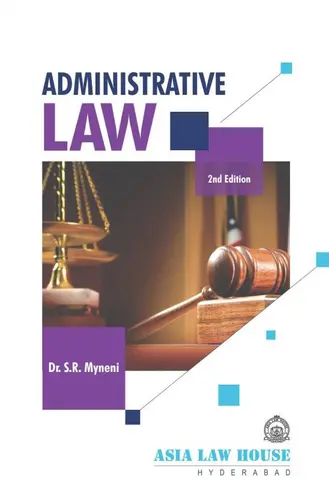
State power consists of legislatures, executive and judiciary. They are not entirely separate organs but have strong bondage. Administration is the function of State and administrative authorities have been evolved separately from legislation and judiciary. It has the duty of implementation of State policies as per statutes enacted by the legislation. In a welfare state, administrative agencies perform a number of functions fairly and without arbitrariness. Abuse and misuse of power by the administrative authorities creeped in as time passed on and a separate law has been required to control the executives, various public institutions and agencies. Rule of law is essential not only to the public but also to administrative wing. The whole state structure is dependent on the ability and efficiency of the administration. The subject Administrative Law is of recent origin and witnessed tremendous growth and development in twentieth Century. It started as 'Droit Administratif in France and later occupied the globe as 'Administrative Law based on Common Law of England and through the decision of Courts. India too adopted the common law of Anglo-Saxon system under the British rule. After the independence, India has its own Constitution and provisions relating to administrative agencies. Along with this we continued the common law in practice under the control of judiciary power of higher courts. In this volume, the whole administrative law has been presented in five unites: (i) Nature and Scope of Administrative Law; (ii) Basic Concepts; (iii) Classification of Administrative Functions; (iv) Judicial Control of Administrative Action, and (v) Remedies available against the State. The subject has been presented comprehensively in simple language, in concise form and in lucid style. No text book writer can claim the originality of thought, as the topics explained are based on references.